
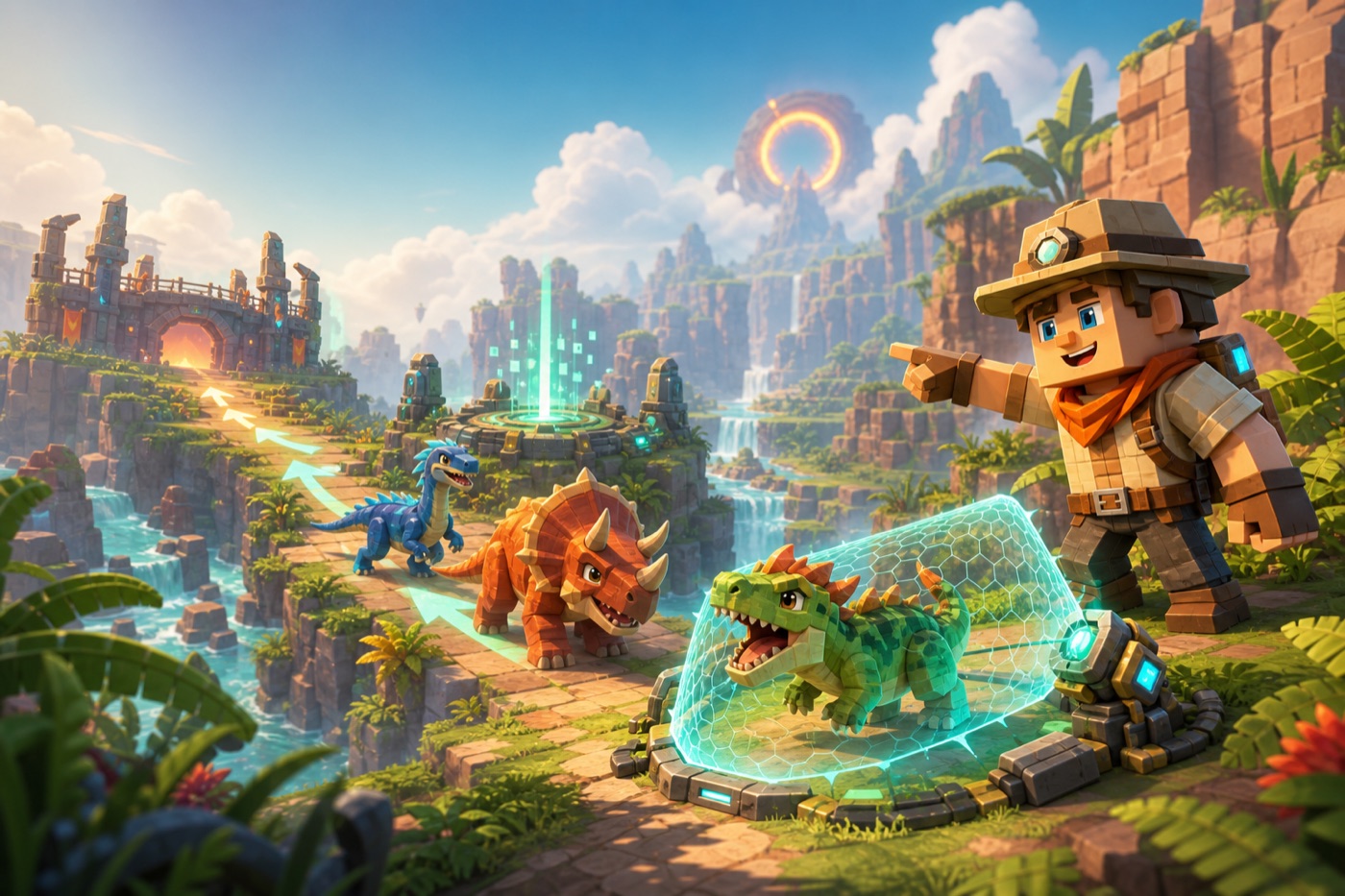
Gameplay in one sentence
Dino Hunters gameplay begins with hunting dinosaurs and turns successful captures into a team you can train, upgrade, evolve, rank up, battle with, and take into new worlds.
The confirmed progression route
- 01
Hunt dinosaurs in the prehistoric world using the current live-game tools.
- 02
Capture and collect dinosaurs to begin building a team.
- 03
Train the team, then use the listed upgrade, evolution, and rank-up systems.
- 04
Battle with the developed dinos and continue toward new worlds and rare discoveries.
What the official description does not settle
The listing explains the high-level gameplay loop, but it does not publish fixed weapon names, capture rates, combat formulas, dinosaur stats, rarity tables, price lists, or a complete world directory. Those limits are important. A guide can explain how the systems connect without making up values that may change or may never exist in the live experience.
Use the live interface to turn the broad loop into a personal route. Note the names the game uses for your collection, training options, upgrades, battles, and worlds. If a later official update supplies precise details, a guide can add them with a date and a source. Until then, the strongest help is a clear explanation of what the public description already confirms. This keeps the page useful for a returning player without pretending that an unpublished menu, rate, or combat number is already settled.
Hunt: the start of every team decision
The loop starts with the hunt. The official page tells players to grab a weapon and enter a prehistoric world where they can shoot dinosaurs. That establishes the opening action, but it does not require a guide to guess exact weapon types or damage numbers. A first-time player should instead look for the current target feedback, the route into a dinosaur encounter, and the moment when a hunt becomes a capture opportunity. Those visible steps create a dependable beginning even when a later update changes the balance.
Hunting matters because it leads into collection rather than ending at a score screen. A useful note from a Dino Hunters session is not just which dinosaur appeared; it is how the current game connects the encounter to a result. Did the game show a capture choice, a reward screen, or a collection update? Record what you can see and avoid filling in the rest. This makes the game easier to revisit and keeps the guide close to Dino Hunters rather than a generic dinosaur shooter.
- The official description confirms dinosaur hunting.
- Exact weapon names and damage values are not published here.
- Use live encounter feedback to learn the current capture path.
Capture and collect: turn an encounter into a roster
The official description says players can catch and collect dinos to build their strongest team. This is the bridge between exploration and progression. After a capture, look for the collection view and any team-selection step. A collection is more than a list of creatures when the game lets those creatures participate in later training or fights. The public evidence supports that idea; it does not yet support a named index with individual strengths, weaknesses, or tier ranks.
That distinction helps a player avoid a common mistake: assuming a full-looking community roster applies to this experience. Until a current official source names the available dinosaurs and their data, use the live collection as your reference. If a dinosaur is visible in your account, you can learn where it appears in the interface and how it joins your team. If it only appears in an undated list, it remains a claim to check rather than a fact to organize a build around.
- Capture and collection are confirmed.
- Team building is confirmed.
- Named roster details remain open.
Train, upgrade, evolve, and rank up: develop what you keep
Training, upgrades, evolution, and rank-ups form the development section of Dino Hunters gameplay. The listing names all four, so a new player can reasonably look for them after building a team. The right question is not which upgrade a guide claims is best; it is which system the current game exposes, what it changes on screen, and how it relates to a dinosaur you collected. Follow the live labels and avoid any promise about costs or breakpoints that cannot be checked.
Progression systems work best when you understand the sequence. Training may be a team-development action, while an upgrade or evolution may focus on an individual dino; the current interface should tell you which. Rank-ups are also part of the official description, but their requirements are not published in the evidence used here. If a menu gives you a rule, note it with its date. If it does not, keep the claim broad and let a future verified update add the detail.
- Training, upgrades, evolution, and rank-ups are official terms.
- Costs and thresholds are not treated as verified here.
- A current interface label is stronger than an old guide claim.
Battle and explore: test the team in new worlds
The listed loop reaches beyond collection. Players can battle in dino fights, explore new worlds, and discover rare dinosaurs. These promises give the team a reason to exist: it can be developed, then used in a new situation. When you reach a battle or a new area, focus on the visible rules. Notice how the game presents a team choice, what it calls success, and how it signals a world change. This is practical gameplay information that does not require a made-up map or a speculative combat chart.
Rare discoveries are also part of the official description, but rare does not mean a guide should promise a spawn chance or route. A sound way to approach the feature is to return to the current Dino Hunters game after updates and watch for details that the developer or the live interface makes explicit. As evidence grows, this guide can become more specific. Until then, the whole gameplay path is still clear: hunt, capture, collect, develop the team, battle, and explore.
- Dino fights and new worlds are confirmed by the listing.
- Rare dinosaurs are named, but probability data is not published here.
- Use live rules to guide a battle or exploration decision.